
Skip to content
Citations Citations
Blog About Request Access

Blog

Insights on licensed, attributed AI access to authoritative content.

How Researchers Use AI: Anthropic Counted the Tasks, Not the Sources

Anthropic's study of 207,049 research sessions shows how scientists use Claude, led by data analysis, manuscript drafting and literature synthesis. It also shows that a platform can classify usage at scale while retaining only task labels. It does not record which sources each task relied on, which is the information publishers need for licensing.

Francois-Xavier Bioul Francois-Xavier Bioul 8 min read

How Publishers Should Measure Visibility in AI Answers Beyond Clicks

Google Search Console now reports AI Overview and AI Mode impressions for every site. A five-layer scorecard turns that signal into publisher measurement: citation visibility, accuracy, catalogue coverage, post-answer demand and assisted outcomes, each with the limit a rights holder must state.

Francois-Xavier Bioul
9 min

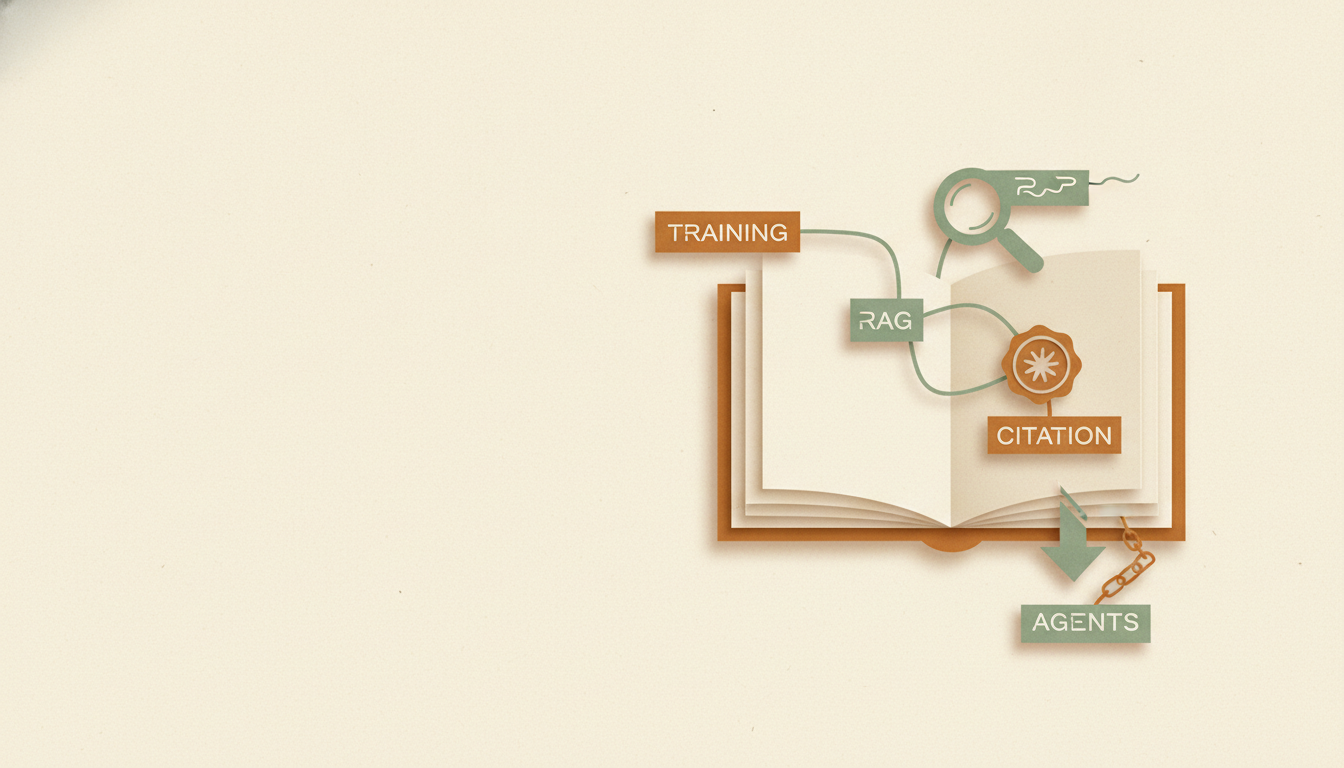
Training, RAG, Citation, Agents: How to Split an AI Content License

An AI content license bundles uses that behave differently: training changes a model once, RAG retrieves on every query, citation qualifies a use and agents fetch on demand. This article sets out a matrix of rights, records and payment models for each, aligned with RSL, IETF and Cloudflare vocabularies.

Francois-Xavier Bioul
8 min

AI Act Article 50 vs Article 53: The Evidence Publishers Should Keep

Article 50 of the AI Act asks publishers to prove what they did with AI. Article 53 lets them prove what AI providers did with their content, but only with their own records. Ten records to keep since August 2026, split by article and by owner.

Francois-Xavier Bioul
11 min

Six Acceptance Tests for an AI Tutor Built on Licensed Educational Content

Licensed content gives an AI tutor a defined corpus and a contractual basis. It does not show that the assistant cites the right passage, stays within the license, protects student data or helps students learn. Six acceptance tests turn those claims into a procurement decision.

Francois-Xavier Bioul
9 min

Who Can Upload Content to AI? Input Authority for Publishers and RROs

Access to a manuscript, a license file or a member database does not give permission to put it into an AI system. Publishers and RROs need a rule between access and use: who may upload which content, into which environment, for which operation, and what record shows that the operation stayed within those limits.

Francois-Xavier Bioul
7 min

AI Licensing: Calculate the Break-Even Threshold Before You Negotiate Price

The headline price of an AI license says little about its margin. Two deals at the same rate can diverge by EUR 170k in cumulative contribution once preparation costs, run costs and royalty shares are accounted for. This article gives the formula to calculate the floor before negotiating.

Francois-Xavier Bioul
5 min

When AI Licensing Deals Become Evidence in Court: The Mosaic Discovery Fight

A discovery order in a books-and-AI-training case, and an amicus brief from AAP, News/Media Alliance and STM in the same litigation, both treat the AI licensing market as part of the fair use analysis. This article explains how companies should document licensing negotiations as a result.

Francois-Xavier Bioul
7 min

AI Act Article 50: What Breaks the Editorial Exception After Sign-Off

Article 50(4) exempts human-reviewed AI text from disclosure, but the exemption protects the version a person actually reviewed. A faithful AI translation stays inside that protection; an AI summary, rewrite or SEO pass that changes structure or meaning does not, and the published version needs its own review.

Francois-Xavier Bioul
7 min

Permalinks, Framing and CMI: What Emmerich v. Particle Media Means for Publishers

On August 27, 2026, the Fifth Circuit held in Emmerich v. Particle Media that URLs are not categorically excluded from copyright management information under the DMCA, but most permalinks will not qualify as drafted. The ruling also replaced the server test for framing. A four-factor audit for publisher permalinks.

Francois-Xavier Bioul
11 min